
Mon–Thu 8AM–5PM | Fri 8AM–2PM
Home / General Dentistry / Dental X-Rays
Digital dental X-rays at New Day Dental & Medical Aesthetics show what a visual exam cannot, like cavities between teeth, infection at the root, and bone levels, using a low dose of radiation and only when your care calls for it.
Digital
Images ready on screen in moments
When needed
Every image has a clinical reason
In-network
with Delta Dental and Blue Cross Blue Shield
Saturdays
Open select Saturdays for busy schedules
Dental X-rays
A healthy smile depends on more than what you can see in the mirror. Early decay between teeth, bone loss from gum disease, and infection at the tip of a root can all progress quietly, without pain or visible signs. Dental X-rays, also called radiographs, show the teeth, roots, and jawbone beneath the surface, so these problems can be found while they are still small.
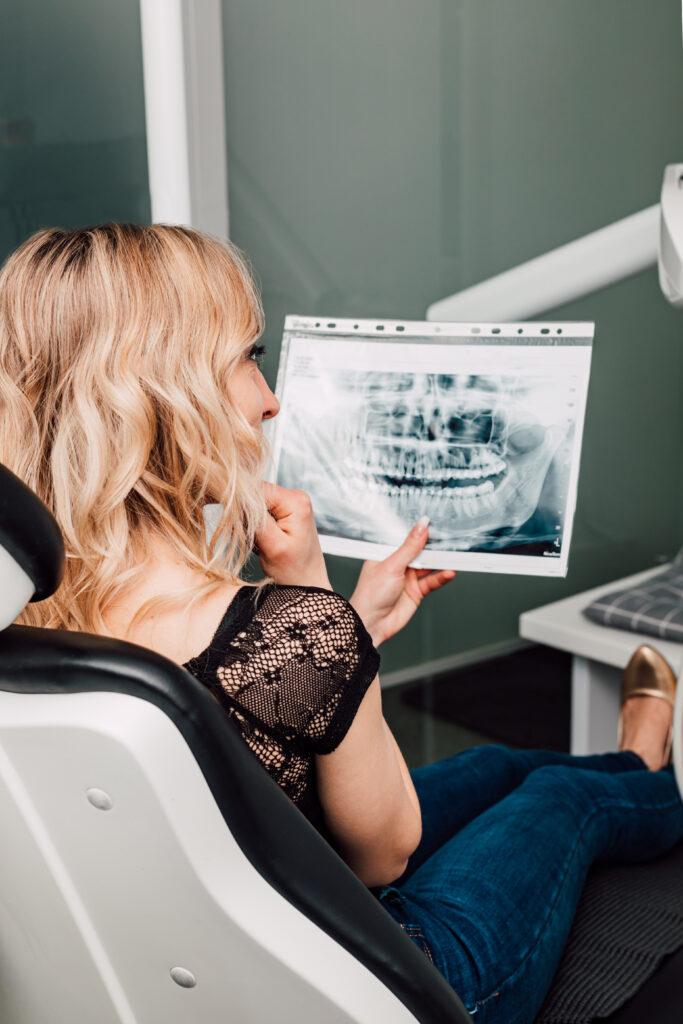
At New Day Dental & Medical Aesthetics, X-rays are part of the general dentistry care we provide for patients of all ages. Our digital system uses a small sensor and a low dose of radiation, and the image appears on screen within moments, so Dr. Jordan Tucker can review it with you during your routine exam.
Types of X-rays
Each type of image answers a different question. Dr. Tucker chooses the one that fits what needs to be seen, so you are not exposed to more imaging than your care requires.
These show the upper and lower back teeth together, which makes them useful for finding cavities between teeth and checking the fit of fillings and crowns.
Cavity checks
These show a whole tooth from crown to root tip, helping identify abscesses, cysts, and problems in the bone around the root.
Root and bone detail
One image captures the entire mouth, including the jaw joints, sinuses, and all teeth, often for treatment planning or checking wisdom teeth.
Full-mouth view
When a flat image is not enough, a CBCT scan gives a three-dimensional view for implant planning and other complex cases.
Used selectively
Images help us track incoming permanent teeth and jaw development and can show alignment concerns early.
Growing smiles
New patients often receive a more complete set of images, giving us a clear starting point for tracking changes over time.
Your starting point
Have recent X-rays from another dental office? Ask them to send copies, and we may not need to take new ones. Book an exam
What to expect
Digital X-rays take only a few minutes and are usually part of a routine exam visit. Here is what the process looks like.
Dr. Tucker considers your history, age, risk for disease, symptoms, and the date of your last images before recommending any X-rays.
Our team positions you comfortably, places a small sensor in your mouth, and focuses the beam on the area being checked.
Each exposure takes a moment. Digital images appear on screen right away, with no film or chemical processing.
Dr. Tucker walks you through what the images show and explains any findings and next steps in plain terms.
How often you need X-rays
According to the American Dental Association, how often X-rays are taken depends on your present oral health, your age, your risk for disease, and any signs or symptoms. Children and teens may need them more often because their teeth and jaws are still developing, and ADA recommendations from 2024 call for X-rays only when your dentist believes they will provide needed diagnostic information.
Why New Day Dental
X-rays are one of the most useful tools in dentistry when they are used thoughtfully. Here is how we approach them at our Cary office.
Our digital system uses less radiation than older film X-rays and shows images right away. See more of our technology.
We follow the ALARA principle, as low as reasonably achievable. Every image has a clinical reason, and we are happy to explain it.
Dr. Tucker is trained in CBCT 3D imaging, so complex cases can get a more detailed view in the same office.
When they help
There is no single schedule that fits everyone. Dr. Tucker weighs your age, oral health, risk factors, and symptoms to decide when new images will help.
For questions a flat image cannot answer, Dr. Tucker may recommend 3D dental imaging. Most X-rays are taken during a routine dental exam, so there is usually no separate appointment.
Insurance & payment
Coverage for X-rays varies by plan and by how often images are taken. Our team verifies your benefits before your visit and explains any out-of-pocket cost.
We are in-network with Delta Dental and Blue Cross Blue Shield and accept most other major PPO plans. Bring your insurance card so we can confirm your diagnostic benefits.
No insurance? Our in-house plan covers preventive care and adds discounts on additional treatment for one flat annual fee. See the VIP Membership Plan
If your X-rays show treatment you need, financing options are available for larger plans. Ask our team about options at your visit.
Before you book
There is no special preparation for dental X-rays, but a little information ahead of time helps us avoid repeat imaging and get the right images.

DDS
West Virginia University
Your dentist
Owner & lead dentist
Dr. Tucker completed undergraduate studies as a scholarship student-athlete and went on to earn a dental degree from West Virginia University. Before leading New Day Dental & Medical Aesthetics, Dr. Tucker owned a private practice and served as clinical faculty, mentoring future dental professionals.
Dr. Tucker uses digital imaging during routine exams to catch potential concerns early, often before you notice symptoms, and is trained in CBCT 3D imaging for cases that need more detail. Every image is reviewed with you, so you understand what it shows and why it matters for your care. Read Dr. Tucker’s full bio
Patient reviews
FAQ
Do not see your question here? Call us and our team will help.
Dental X-rays use very low doses of radiation, and digital systems use less than older film X-rays. We take images only when they are needed for your care and keep exposure as low as reasonably achievable.
It depends on your oral health, age, risk for disease, and any symptoms. New patients often need a baseline set, while patients with stable oral health may need X-rays less often than those at higher risk.
X-rays can show cavities between teeth or under fillings, infection at the root, abscesses, bone loss from gum disease, impacted teeth, and how adult teeth are developing in children.
Standard X-rays are flat, two-dimensional images that work well for most checkups. 3D dental imaging uses CBCT to create a three-dimensional view and is saved for complex cases, such as implant planning.
Often, yes. Children and teens may need X-rays more often than adults because their teeth and jaws are still developing. Images help us monitor incoming permanent teeth and spot problems early.
Yes, in many cases. If your previous dentist has recent images, ask them to send copies before your visit. Dr. Tucker will review them and take new images only if they are needed.
Get started
Dr. Jordan Tucker and our team use digital X-rays, and 3D imaging when needed, as part of routine exams for patients of all ages in one Cary office.
Call (919) 701-2922 or complete our contact form to schedule your exam. We welcome patients from Cary, Apex, Holly Springs, Morrisville, and across Wake County.
Visit us
1223 Parkside Main St.
Cary, NC 27519
Get directions →
Office hours